
How to Choose the Right Air Duct Cleaning Company in San Pedro
Choosing the right air duct cleaning company in San Pedro comes down to one thing most guides never mention: the equipment that actually shows up at your door. A legitimate contractor runs a negative-pressure containment system with rotary agitation and HEPA filtration. A low-bid operator runs a glorified shop vac. The difference determines whether debris gets extracted from your ducts or simply redistributed through your living room. If you’d rather skip the homework, call (877) 573-0759 for a free estimate.
Most “how to choose” articles hand you the same tired checklist: check for certification, read reviews, compare prices. Fine advice, as far as it goes. But here’s the problem we see every week in San Pedro: NADCA membership costs about $300 a year and requires no equipment inspection. A company can display that logo while running consumer-grade gear that couldn’t pull dust out of a coffee can. So let’s talk about what actually separates a real cleaning from theater, starting with the three questions that matter.
Question 1: What Are You Using for Negative Pressure?
This is the first question to ask any duct cleaning company in San Pedro, and most homeowners have never heard of it. Negative pressure means the system pulls more air out of your ducts than it pushes in. That pressure differential is what keeps dislodged debris from escaping into your home during the cleaning.
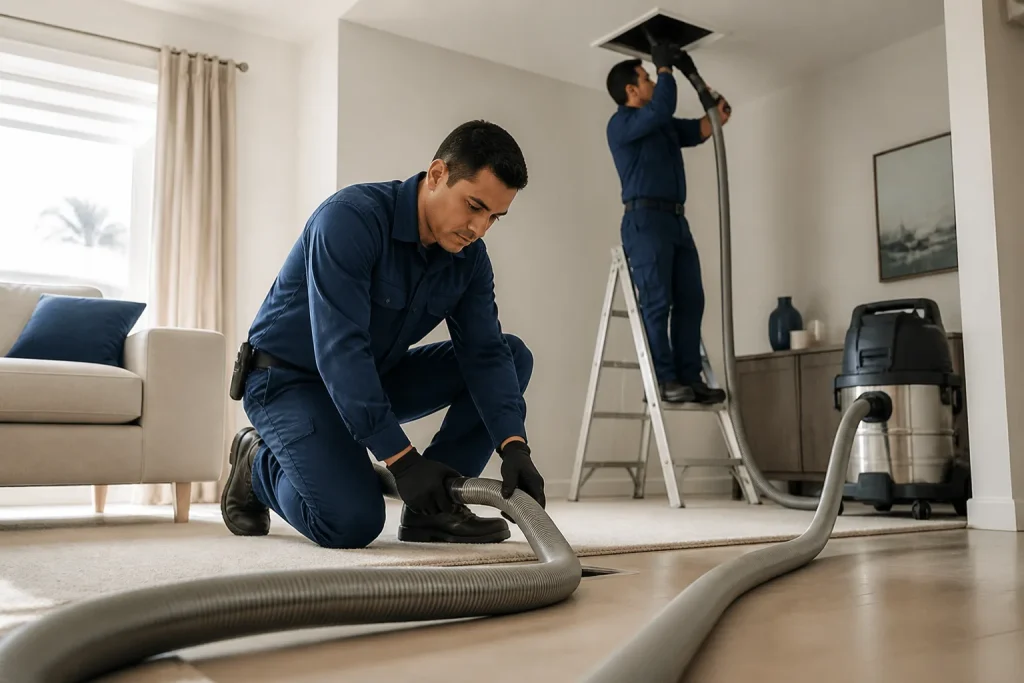
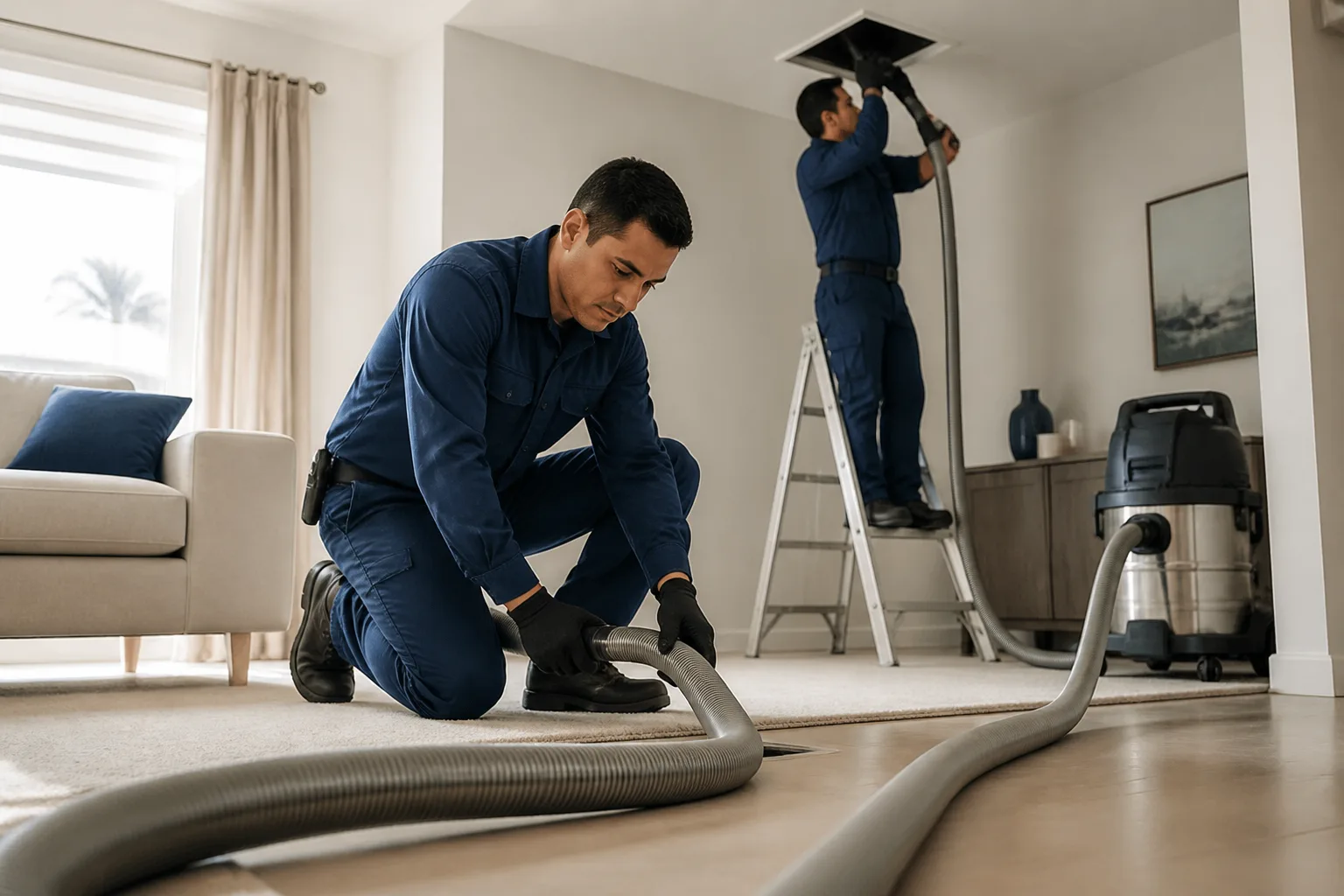
A proper setup uses a powerful vacuum unit connected to your duct system, often through a trunk line access point, creating continuous suction while the cleaning happens. The machine typically stays outside or in a contained area, venting through HEPA filtration. Consumer-grade equipment can’t generate meaningful negative pressure. It agitates dust and hopes for the best.
Ask the company directly: “What negative pressure system do you use?” A serious contractor answers with a brand and a specification. Abatement Technologies, for example, makes negative-air machines designed for hospital and restoration environments. That’s the caliber of equipment that belongs on the job. A company that stumbles on this question or says something vague like “we have powerful vacuums” just told you what you need to know.
The practical test is simple. With real negative pressure, you can hold a tissue near a supply register during cleaning and watch it pull toward the vent. That’s not a magic trick. That’s physics working in your favor.
Question 2: Do You Use Rotary Brush Agitation?
Negative pressure alone isn’t enough. Dust and debris in ducts doesn’t just sit there politely waiting to be vacuumed. It adheres to duct walls in a layer that builds up over years: skin cells, pet dander, construction dust, cooking residue, and whatever else circulates through a San Pedro home near the harbor. You need mechanical agitation to break that bond.
Rotary brush systems feed a spinning brush through the ductwork, scrubbing the walls while the negative pressure simultaneously extracts what’s knocked loose. The Rotobrush contact-vacuum design does both in one pass: the brush head sits at the point of contact, so debris gets pulled out the moment it’s dislodged. It’s the same approach restoration contractors use after a fire or flood. Nikro machines work on the same principle and are standard equipment for serious HVAC and remediation crews.
If a company shows up with only a vacuum hose and a wand, they’re not cleaning your ducts. They’re giving them a light dusting. Ask: “What agitation system do you use?” Listen for a brush system, not just suction. No brush, no clean. It’s that straightforward.
Question 3: What Does Your Filtration Setup Look Like?
This is where we’ve seen San Pedro homeowners get burned in ways they don’t notice until a week later. A company agitates all that accumulated debris off the duct walls, but if their filtration is weak, a significant portion escapes into the home. Now you’ve got ten years of dust settling onto your furniture, your bedding, your kitchen counters.
HEPA filtration rated at 99.97% efficiency for particles down to 0.3 microns is the standard you want. The negative-air machine should be running through HEPA filters, and the containment setup should prevent unfiltered air from entering living spaces during the job. Abatement Technologies equipment, common in mold remediation and hospital construction projects, is built around this containment principle. The debris gets captured, not redistributed.
Ask specifically: “Does your setup include HEPA filtration, and how do you contain the area during cleaning?” A legitimate operator explains the process. A low-bid operator says “we put down drop cloths.” Those are different answers to different questions.
NADCA Certification vs. Equipment Reality in San Pedro
NADCA (the National Air Duct Cleaners Association) sets industry guidelines, and membership signals that a company at least knows the standards exist. We’re not knocking certification. But here’s what the marketing materials won’t tell you: NADCA membership doesn’t require proof of professional-grade equipment. Pay the fee, follow the ethics code on paper, and you’re in.
The gap between “NADCA certified” and “runs contractor-grade equipment” is wider than most homeowners in San Pedro realize. We’ve seen certified operations working out of pickup trucks with portable units that wouldn’t pass a restoration company’s trash inspection. Meanwhile, some companies run Rotobrush and Nikro systems, work around the equipment restoration pros rely on, and produce results you can actually see and measure.
Verification beats certification every time. Ask for the equipment brands by name. Ask to see the setup when the crew arrives, before they start. A company confident in its tools won’t hesitate to show you. A company hiding something will deflect to their certificate.
What a Legitimate Pre-Job Walk-Through Looks Like
A real duct cleaning in San Pedro starts before any equipment comes off the truck. The technician should walk your home, inspect the access points to your duct system, check the duct material, and assess the contamination level. That assessment drives the cleaning approach: a home with pets and carpet needs different handling than one with recent construction dust or a crawl-space moisture issue.
What does a quote-without-assessment look like? It sounds like this: “How many vents do you have? Okay, that’ll be $X.” No walk-through, no inspection of the trunk line, no questions about whether you’ve got flex duct or rigid sheet metal, no mention of accessing the return plenum. Just a price based on vent count.
That pricing model, per-vent pricing, should actually raise an eyebrow. It incentivizes rushing through vents rather than cleaning the system properly. A flat price per system, agreed before work starts, tells you the company is thinking about the job as a whole, not a count of registers to hit as fast as possible. We pulled a collapsed flex duct out of a hillside home near Averill Park last month that two prior “cleanings” had simply blown past, because nobody had actually looked at the system. The homeowner had paid twice for nothing, and the repair took one visit to set right.
Reading Reviews Like a Duct Cleaning Expert
Online reviews for duct cleaning companies follow patterns, and once you know what to look for, the quality signals jump out. Generic reviews read like this: “Great service, friendly technician, would recommend.” That tells you the technician was pleasant. It tells you nothing about whether the ducts got cleaned.
Reviews written by homeowners who got real results include specifics. They mention visible debris extraction: “He showed me the canister afterward, it was full of pet hair and construction dust from when we remodeled.” They mention process details: “They sealed off the registers, ran the HEPA filtration the whole time, and I could feel the air pulling from the vents.” They mention documentation: “I got before-and-after photos of every section they cleaned.”
Placebo satisfaction is real in this industry. A homeowner who didn’t know what to expect feels good about a polite crew that showed up on time, even if the cleaning was superficial. The phrase “very professional” without any follow-up detail is the tell. Look for reviews that describe what was done, not how the technician made them feel. If a company’s reviews are all “friendly and courteous” with zero mention of equipment or results, that’s a pattern worth noticing.
The Post-Job Documentation Standard
A legitimate contractor leaves behind evidence. Before-and-after photos of the duct interior are standard practice for serious operators. You should be able to see the duct wall before cleaning, coated with whatever years of airflow deposited there, and after cleaning, with the surface visible and clear. If the duct is metal, the metal should look like metal again.
Pressure differential readings add another layer of verification. A static pressure measurement before and after cleaning demonstrates objectively whether airflow improved. If your ducts were restricting airflow due to buildup, the numbers should change. That’s measurable proof, not a technician’s assurance that “it’s all clean now.”
A debris log rounds out the documentation. What came out of your ducts, how much was captured, and where the heaviest deposits were located. This matters because it tells you what you were breathing and what’s no longer circulating. Some companies, working with protective coating products from brands like Guardsman, may also document any repairs or sealing work performed during the visit.
If a company’s post-job documentation consists of an invoice and a handshake, you’ve paid for a show. Demand better. In San Pedro, where homes range from harbor-adjacent bungalows dealing with salt air and humidity to newer construction inland, the contamination profile varies widely. Your documentation should reflect what was actually found in your specific system.
When to Call a Pro
Air duct cleaning is not a DIY project. The equipment needed for proper negative-pressure extraction costs more than most homeowners will ever spend on the service itself, and the techniques for accessing trunk lines and navigating branch runs take training and repetition. Adding a HEPA filter to a shop vac produces a shop vac with a HEPA filter. It does not produce a duct cleaning system.
The same applies to dryer vent cleaning, which is a separate service with real safety implications. Lint accumulation is a leading cause of residential dryer fires, and clearing a vent properly requires specialized brushes that can travel the full vent run and remove caked-on lint from the walls, not just the first few feet. For related services in San Pedro, see our air duct cleaning service page, dryer vent cleaning information, and air duct repair details.
The Bottom Line
The right air duct cleaning company in San Pedro answers three equipment questions without hesitation: what negative pressure system they run, whether they use rotary brush agitation, and how their HEPA filtration and containment work. They walk your home before quoting, price the system rather than the vent count, and leave documentation you can actually verify. The wrong company hides behind a certification and hopes you won’t notice the shop vac in the driveway.
If you’re in San Pedro and want an honest assessment of your duct system, Air Duct Cleaning San Pedro offers free estimates. We run Rotobrush and Nikro equipment with Abatement Technologies negative-air filtration, and we work around whole-home systems including Honeywell and Aprilaire setups. Call (877) 573-0759 and we’ll answer the equipment questions before you even ask them.
Frequently Asked Questions
How do I verify a duct cleaning company actually uses professional equipment?
Ask for the equipment brands by name before booking. A legitimate operator will tell you what negative pressure machine they use, what brush system they run, and what filtration setup they employ, without hedging. When the crew arrives, ask to see the setup. Rotobrush, Nikro, and Abatement Technologies machines are large, identifiable units that don’t fit in a passenger vehicle. If the equipment looks like something from a hardware store, trust your eyes.
Why are some duct cleaning quotes in San Pedro so much cheaper than others?
Cheap quotes typically reflect cheap equipment and a rushed process. A low-bid operator with a portable vacuum and no negative pressure containment can complete a job in half the time with far less effect, which allows them to undercut legitimate contractors. They also tend to price per vent, which incentivizes speed over thoroughness. When comparing quotes in San Pedro, verify what equipment each company runs before letting price drive the decision. A system priced flat, with documented before-and-after results, is not the same product as a per-vent special. Call (877) 573-0759 for an exact quote on your system, estimates are free.
How do I know the cleaning actually worked?
A legitimate contractor provides verifiable evidence: before-and-after photos of the duct interior, pressure differential readings where applicable, and a debris log showing what was removed and from where. You should be able to see the difference in the photos and understand the change in the numbers. If you’re left taking someone’s word for it, the documentation wasn’t done right.
Is NADCA certification important when choosing a San Pedro duct cleaner?
NADCA certification indicates awareness of industry standards, but it does not verify equipment quality. Membership is fee-based and does not require inspection of the tools a company actually uses. The more meaningful verification is equipment-based: ask what negative pressure system, brush agitation method, and filtration setup the company runs. Contractor-grade equipment brands like Rotobrush, Nikro, and Abatement Technologies are harder to fake than a certificate.
Written by the team at Air Duct Cleaning San Pedro, serving San Pedro since 2017.
Need Air Duct Cleaning Help?
Call Air Duct Cleaning San Pedro - licensed & insured, here with fast help in San Pedro.
(877) 573-0759