
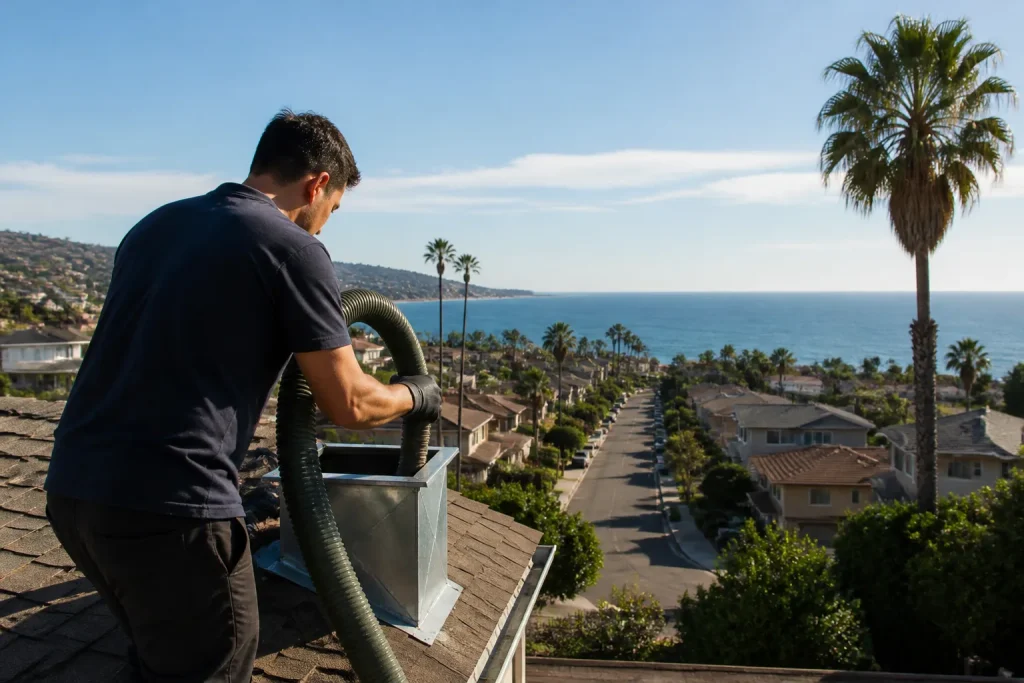
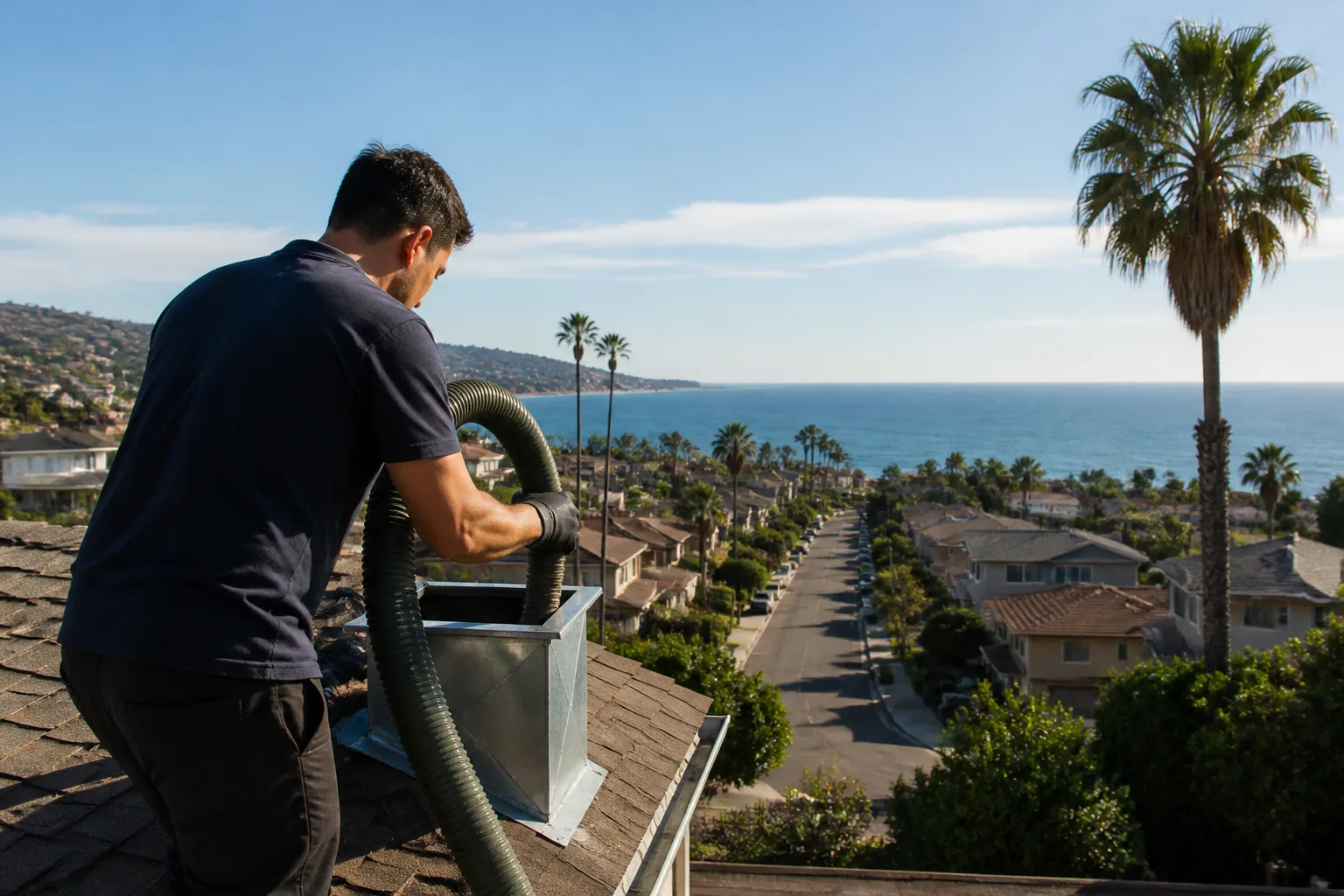
Emergency Air Duct Cleaning Near Me: What San Pedro Homeowners Should Do First
Most “emergency duct cleaning” calls we get in San Pedro aren’t emergencies at all. A real emergency is smoke from the 110 freeway pushing soot into your HVAC, a flood leaving standing water in your return, or a blower motor that shredded itself and sent debris through every register. If a door-knocker told you your ducts are “critically contaminated” after a 30-second look, that’s a sales tactic. Here’s how to tell the difference and what to do before anyone touches your system. If you’d rather skip the detective work, call (877) 573-0759 and we’ll walk you through it.
What Actually Counts as a Duct Emergency in San Pedro
Three scenarios justify treating duct cleaning as urgent. Everything else can usually wait for a scheduled appointment without real consequence.
1. Post-fire soot infiltration. San Pedro sits close to refinery and port activity, and when the wind shifts, fine particulate finds its way into HVAC returns. A nearby structure fire is worse. Soot is acidic, it doesn’t just sit in ducts, it corrodes metal, embeds in insulation, and cycles through your house every time the blower runs. If you can smell smoke coming from your registers after a nearby fire, that’s a genuine emergency.
2. Post-flood or water intrusion into ductwork. San Pedro’s marine layer keeps things damp, and a leaking supply line, failed water heater, or storm intrusion that reaches your ducts creates a mold timeline measured in hours, not days. Wet fiberglass duct liner and damp dust are exactly where mold colonizes fastest. If you had water in or near your return vents, don’t wait.
3. Catastrophic component failure. When a blower motor bearing seizes or a fan blade comes apart, it can send metal shavings, melted plastic, and belt debris through the entire duct run. Running the system after that spreads contamination further. Shut it down and get a professional with containment equipment involved.
What’s not an emergency: dusty vents after a remodel, a musty smell that’s been there for months, or a “free inspection” that suddenly found black mold in your duct seams. Those are real problems, but they’re not 2 A.M. problems. For a full rundown on standard cleanings, see our page on Air Duct Cleaning in San Pedro.
What to Do in the First 24 Hours
Your actions in the first day after a smoke or water event determine how hard, and how expensive, the remediation gets. Here’s the protocol we recommend to San Pedro homeowners, in order:
- Turn the HVAC system off at the thermostat. Then switch the breaker off at the panel. You want zero air movement through contaminated ducts. Air movement spreads soot into fibers and furniture and drives moisture deeper into duct liner.
- Close all registers and returns. Tape them over with plastic sheeting or even kitchen plastic wrap if you can. This limits cross-contamination into living areas while you figure out next steps.
- Document everything before you touch anything. Take photos of the event: standing water, soot streaks at registers, the source of the damage. Your insurance carrier will want a record. Write down when you first noticed the problem and what you did.
- Do not run a shop vac into your ducts. It agitates what’s in there and exhausts fine particulate right back into the room through the vacuum’s own filter. You’ll make the problem measurably worse.
- Have key information ready before calling a contractor. Know your system type (forced air, heat pump), approximate square footage, the number of returns, and what happened. A serious operator will ask these questions before quoting anything.
In genuine smoke or flood scenarios, standard portable equipment isn’t enough. That’s where restoration-grade containment matters. We run Abatement Technologies negative-air and HEPA filtration units during emergency work because the point isn’t just loosening debris, it’s capturing it before it re-enters your rooms. That distinction is the difference between a cleaning and a re-contamination event.
Why Running Your HVAC After Smoke or Flood Makes Everything Worse
This is the single most common mistake we see in San Pedro homes, and it’s understandable. After a flood, you want airflow to dry things out. After a fire, you want the smell gone. So people flip the system back on.
Here’s what happens. Soot particles are electrostatically charged and cling to every surface they touch. Run the blower and you deposit a fine layer of soot into carpet, drapes, upholstery, and painted walls. What was a duct cleaning is now a full interior repaint and soft-goods replacement. With water, running the system pushes humid air into duct insulation and cold spots in the system where it condenses. Mold that would have been localized now has a highway through your entire home.
Every hour you run a contaminated system turns a four-hour duct remediation into a multi-day restoration project. Shut it down, seal the openings, and call someone who handles this with the right containment approach. Our Air Duct Cleaning in San Pedro service covers post-event cleaning with the same Rotobrush contact-vacuum systems restoration contractors use, paired with HEPA capture, so dislodged material is extracted rather than redistributed.
The Red Flags: When “Emergency” Is Just a Sales Script
This industry has a reputation problem, and a chunk of it comes from operators who manufacture urgency to close a sale. San Pedro homeowners tell us variations of the same story: a $49 “whole house special” that balloons to $900 once the tech flashes a photo of “mold” that’s just dust accumulation.
Here’s what a high-pressure sales visit looks like, versus a legitimate service response:
- They can’t explain what they found without jargon. A legitimate tech will show you the debris, tell you what it is, and explain why it matters. If every answer is “this is a serious health hazard” with no mechanism, that’s theater.
- They pushed a camera into one duct and declared the whole system “critically contaminated.” Real inspection means looking at multiple points: supply, return, plenum, blower compartment. One photo is not diagnostics.
- The price changes after they “take a closer look.” Bait-and-switch pricing is the oldest trick in this trade. A flat price per system, agreed before work starts, eliminates it.
- They won’t show you what came out. Any serious operator can show you what was extracted, either in the collection chamber of a Nikro or Rotobrush unit or in before-and-after photos of your actual registers. If there’s no proof of process, there was no process.
- They need an answer today or the price goes up. Legitimate contractors don’t use scarcity to close. A real emergency response is about containment and timelines, not pressure.
One more thing: if someone knocks on your door in San Pedro claiming they “just finished a job in the neighborhood” and noticed your vents from the street, close the door. That’s a canvassing script, not an inspection.
What Restoration-Grade Equipment Actually Does Differently
Most residential duct cleaning equipment is a brush on a drill and a vacuum that exhausts inside your house. In a genuine emergency, that’s inadequate. Here’s what separates professional-grade systems in real contamination scenarios:
Contact vacuum extraction. A Rotobrush system scrubs duct walls with a mechanical brush while a HEPA-filtered vacuum pulls dislodged debris out simultaneously. The debris is captured at the point of contact, not blown downstream.
Negative air containment. Abatement Technologies HEPA units put the work area under negative pressure, which means airborne particles are drawn into the filtration unit instead of drifting into your living room. This is standard practice in restoration work and the thing most residential cleaning outfits don’t have.
System-wide access. Proper cleaning means accessing the supply plenum, return drops, and blower cabinet, not just shoving a hose down registers from the living room side. If the return side isn’t addressed, you’ve cleaned half the system.
Repair capability on site. Emergency scenarios often uncover damage: a failed damper, dislodged duct sections, crushed flex runs. When we find it during a San Pedro job, we can address it as part of air duct repair in the same visit, instead of telling you to find another contractor.
We also work around Aprilaire filtration and humidity equipment regularly. If your system includes a whole-home air cleaner or humidifier, that equipment needs to be isolated and addressed during cleaning, not ignored or damaged by someone who’s never seen one before.
When to Call a Pro (and When You Can Wait)
Here’s the honest rule. If you had water, fire, smoke, or a failed system component, call a professional before you run the HVAC again. That’s a protective measure, not an upsell. Call (877) 573-0759 and we’ll help you triage the situation over the phone, whether or not it turns into a job for us.
If your ducts are just dusty, you’ve never had them cleaned, or you noticed dust accumulation around registers during normal operation, that’s a scheduled maintenance item. Book it like you’d book an oil change: not an emergency, but not something to defer for three years either.
The real distinction is whether running your system is actively making your house worse. If the answer is yes, that’s an emergency. If the answer is “it’s been like this for a while,” it’s a cleaning appointment, not a 911 call.
The Bottom Line
San Pedro homeowners should treat “emergency duct cleaning” with the same skepticism they’d give an emergency roofer after a rainstorm. Genuine emergencies exist: post-fire soot, post-flood moisture, and system failures that pump debris through every room. In those cases, shut the system down, seal the openings, document everything, and call a provider with containment-grade equipment, not a shop vac and a truck. Most “emergencies” from door-knockers and online ads are just urgency theater. Trust evidence, not pressure.
If you’re in San Pedro and dealing with smoke, water, or a system failure in your ducts, Air Duct Cleaning San Pedro home service offers free estimate calls. We’ll tell you honestly whether it’s an emergency or a scheduled clean. Call (877) 573-0759.
Frequently Asked Questions
Yes, but only in specific circumstances. Post-fire soot infiltration, post-flood water in ductwork, and catastrophic HVAC component failure are legitimate emergencies because delaying cleaning causes additional damage. A dusty system that’s been dirty for years is not an emergency, it’s a maintenance item. If you’re not sure which category you’re in, call (877) 573-0759 and we’ll help you figure it out over the phone.
Response time depends on the severity of the event and your location within San Pedro. Post-fire and post-flood situations should be addressed within 24 to 48 hours to minimize secondary damage like soot migration into soft goods or mold colonization in wet liner. The most important thing you can do in the meantime is shut the system down at the breaker and seal your registers so contamination doesn’t spread. Call (877) 573-0759 for a same-day phone assessment.
No. Soot is acidic and extremely fine, and consumer equipment can’t capture it effectively. Running a shop vac into your duct system agitates soot and exhausts the finest particles back into your living space through the vacuum’s filter. Professional restoration uses contact-vacuum extraction paired with HEPA negative-air containment to capture soot at the source. This is not a DIY job. Call (877) 573-0759 and we’ll walk you through what’s needed.
Emergency duct cleaning in San Pedro typically runs higher than scheduled maintenance because it involves containment setup, HEPA filtration, and often repair work discovered during the process. Post-fire and post-flood jobs can involve multiple passes and liner replacement. Honest whole-system pricing starts with an on-site assessment, not a per-vent figure that changes once a tech arrives. Call (877) 573-0759 for a free estimate on your specific situation.
In many cases, yes, if the damage is tied to a covered event like a structure fire, water damage from a failed appliance, or storm intrusion. Document everything before cleaning begins: photos of the source damage, soot at registers, water intrusion points, and the system shutoff. Many insurance carriers require evidence that you took immediate protective action, which means shutting the system off right away. Your documentation matters as much as the cleaning itself.
Beyond emergency cleaning, we handle routine Air Duct Cleaning in San Pedro, safety-focused Dryer Vent Cleaning in San Pedro (dryer vents are a leading cause of residential fires, not an upsell afterthought), and Air Duct Repair in San Pedro for damage uncovered during any cleaning visit.
Written by the team at Air Duct Cleaning San Pedro, serving San Pedro since 2017.
Need Air Duct Cleaning Help?
Call Air Duct Cleaning San Pedro - licensed & insured, here with fast help in San Pedro.
(877) 573-0759