
Air Duct Cleaning What It Really Costs: What San Pedro Homeowners Pay in 2026
Most San Pedro homeowners will pay between $350 and $650 for a legitimate whole-home air duct cleaning in 2026. The spread you’ll see in quotes, from $99 specials to $1,200 estimates, rarely reflects the size of your house. It reflects what equipment is on the truck. If you’d rather skip the research and get a straight answer for your specific house, call us at (877) 573-0759.
In 2026, San Pedro homeowners are being quoted anywhere from $99 to $1,200 for the same four-bedroom house. That spread has almost nothing to do with duct count and everything to do with equipment and honesty. We’ll break down exactly why, line by line.
What Actually Drives Duct Cleaning Cost in San Pedro
The number most people assume determines price is the number of vents. That’s wrong, and here’s why: a five-bedroom house in South Shores might have 14 vents, but the real cost variables are hidden in the walls. Linear duct footage. How many stories. Whether the main trunk line is accessible from the attic, a crawl space, or sealed in a slab. Coastal home age matters too. Many San Pedro houses were built in the 1950s and 1960s, and their original ductwork wasn’t designed for the kind of access a thorough cleaning requires.
Here are the four cost drivers that actually move the number:
- Linear duct footage: More duct length means more contact-vacuum pass time. A 1,200-square-foot bungalow near Peck Park might have 80 feet of supply duct. A 3,000-square-foot hillside home off Western Avenue could have 220 feet.
- Access complexity: Slab-on-grade construction, common in San Pedro’s mid-century neighborhoods, often puts ductwork under concrete with limited access points. That takes more time and different tooling than a raised-foundation home with a crawl space.
- Contamination level: Construction dust, pet hair, decades of coastal humidity, and sometimes rodent activity. Heavier contamination means slower passes and more air exchanges before the job is done.
- Equipment class: This is the big one. A shop vac with a brush attachment cannot do what a Rotobrush contact-vacuum system does. The equipment gap explains most of the price gap.
If you want the full breakdown of what matters in our service area, see Air Duct Cleaning in San Pedro.
Why the $99 Quote Structurally Cannot Be Real
Let’s be plain. Nobody can clean a house full of ducts properly for $99. That number is a door-opener. The van shows up, the tech spends twenty minutes doing a visual inspection, and then the real quote starts getting built.
What the upsells typically are:
- Charging per vent instead of per system, which turns the $99 teaser into $600 or more on-site
- Adding a “deep cleaning” or “sanitization” fee that should have been part of the original job
- Claiming mold the moment they see any dark dust, then quoting a remediation package with a scare hook
- Selling duct sealing at $2,000 before the ducts have even been inspected
We’ve had San Pedro customers hand us itemized invoices from these jobs. One from a Rancho Palos Verdes-adjacent neighborhood showed a $99 base quote that became $840 before the tech left the driveway. The kicker: no before-and-after photos, no containment, and the homeowner said the dust came back in two months.
The point isn’t that every low-bid operator is dishonest. It’s that $99 doesn’t cover the cost of running professional equipment, and someone has to pay for the gap. Usually it’s you, on-site, under pressure.
What Contractor-Grade Equipment Actually Costs to Run
Here’s a number most homeowners never consider: a professional Rotobrush contact-vacuum brush system costs a service provider serious money to own, operate, and maintain. A Nikro duct cleaning machine, the brand used by HVAC and remediation contractors, runs on a different tier entirely than the portable vacuums most low-bid crews use. And Abatement Technologies negative-air and HEPA filtration equipment isn’t a consumer product at all. It’s what restoration companies use on flood jobs and mold containment.
When a company invests in this gear, the per-job cost doesn’t just disappear. It has to be built into the quote. That’s not padding. That’s arithmetic.
The equipment matters for one technical reason that changes everything about the job: containment. A vacuum that sucks without a sealed negative-air setup can dislodge debris from your duct walls and redistribute it into the living space. Contractors call that “dust migration.” You’ll see it as a fresh layer of fine dust on your furniture two days after the cleaning. Equipment like Abatement Technologies’ HEPA-filtered negative-air machines capture what gets dislodged. The debris goes into a filter, not your living room. That’s the difference between a real cleaning and theater.
We run Rotobrush contact-vacuum brush systems and Nikro machines precisely because they dislodge and capture simultaneously. The same approach restoration pros use on water-damaged homes. If a San Pedro quote is $149, ask what machine the crew is bringing. The answer is usually “a vacuum.”
San Pedro-Specific Pricing Context Buyers Should Know
San Pedro has two things that shape duct cleaning work more than most Southern California cities: building age and proximity to the port.
Most of the housing stock was built between 1940 and 1980. That means original or semi-original ductwork in many homes. It also means asbestos-era materials in some older properties, which is a separate inspection issue entirely. Older galvanized steel ducts have more seams and more rust potential from coastal humidity. Rust particles don’t just clean off with a brush pass; they sometimes mean the duct itself needs a section replaced rather than cleaned.
Proximity to the Port of Los Angeles introduces particulate levels that inland cities don’t deal with. Diesel particulate from terminal traffic and ships, combined with coastal air, settles in homes. We see darker, finer dust in San Pedro homes than in places like Torrance or Long Beach, particularly in neighborhoods directly under the flight paths.
What this means for pricing: a standard three-bedroom, 1,800-square-foot San Pedro home with accessible ductwork and moderate contamination should run $400 to $550 with a legitimate, equipment-serious provider. If the ducts haven’t been touched in 20 years, or the returns are pulling port dust, expect the higher end. For homes that need more than cleaning, our Air Duct Repair in San Pedro service handles what a brush can’t fix.
How to Read a Duct Cleaning Quote Line by Line
If you’ve got a quote in front of you, here’s how to separate legitimate costs from padding. Go line by line and look for these things:
- Access fees: Legitimate if they’re itemized and explained (like “cutting a second access in a slab-encased trunk line”). Suspicious if they’re vague or added after the fact.
- Per-vent pricing: This is the classic bait-and-switch structure. Honest whole-system pricing should be one flat rate for the entire duct system, agreed before work starts. If the quote multiplies a per-vent number, ask why the linear footage isn’t what’s being priced.
- Sanitization or fogging: Can be legitimate if there’s confirmed microbial growth. But if it appears on the quote before any inspection has happened, it’s padding. A real provider tests or visually confirms before fogging.
- Containment or negative air: This should be standard, not an add-on. If a company charges extra for HEPA containment, they’re asking you to pay separately for what’s baseline professional practice. Abatement Technologies and similar equipment should be part of the core service.
- Repair recommendations: These should reference specific duct sections with photos, not generic “your ducts are old” language. We recently pulled a section of rusty supply trunk out of a home near Leland Park that had collapsed entirely. The homeowner had three prior cleanings and nobody mentioned it. A quote that flags actual damage with evidence is doing its job.
- Dryer vent cleaning as a line item: This is a distinct service with its own fire-safety purpose. It shouldn’t be buried as a $99 add-on or treated as an afterthought. It’s a separate job with separate equipment. See our Dryer Vent Cleaning in San Pedro page for what that actually involves.
The Equipment Gap: What Separates a $400 Quote from a $200 Quote
Let’s walk through the same 1,800-square-foot San Pedro house quoted by two different providers.
The $200 quote: one technician, a portable vacuum with a brush attachment, and a two-hour window. The tech sets up at the return, works through a few vents, and the job is done by lunch. No containment, no camera inspection, no before-and-after photos. The dust in the ducts gets partially agitated, partially removed. Within weeks, your registers are dusty again. You didn’t get a cheaper cleaning. You got a partial cleaning at a partial price.
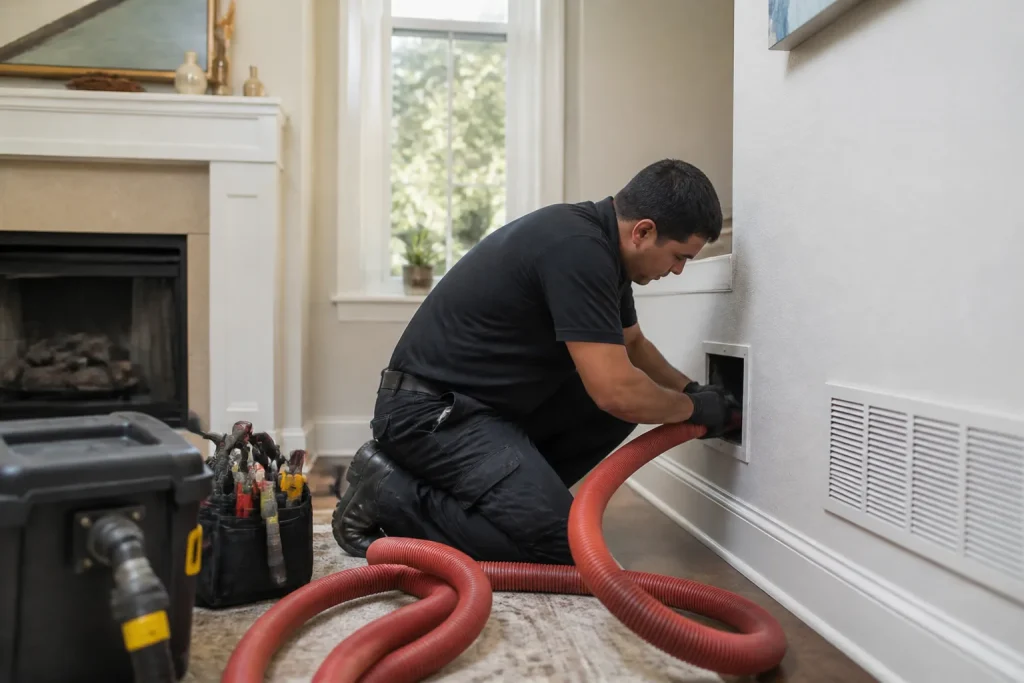
The $400 to $550 quote: contact-vacuum brush passes through every reachable duct section, simultaneous extraction, HEPA-filtered negative air running throughout the job, and containment set up at the return and supply openings. Camera inspection before and after. Photos of what came out. The equipment cost alone explains most of the difference, and the result is a duct system that stays clean longer because debris was actually removed, not just loosened.
One other thing worth knowing: we work around Honeywell and Aprilaire whole-home filtration and humidity equipment regularly. If your San Pedro home has an Aprilaire filter housing or a Honeywell media cabinet, the cleaning process has to account for it. A low-bid crew that doesn’t know what Aprilaire is may not even realize they need to protect or reseat your filter media. That’s the kind of thing that separates a trained HVAC-adjacent provider from a van-and-vac outfit.
Why Dryer Vent Cleaning Is a Separate Line (and Why It Should Be)
Your dryer vent is not part of your HVAC duct system. Different duct, different location, different risk. The National Fire Protection Association has long identified clothes dryer vent fires as a leading cause of residential fires, and most of those fires trace back to lint accumulation in an unmaintained vent. That’s not a convenience issue, it’s a safety issue. For San Pedro homes with laundry rooms tucked against exterior walls, the vent run is often short. But in townhomes and older homes where the laundry sits mid-house, the vent can run 15 or 20 feet with multiple bends. Every bend is a lint trap.
Dryer vent cleaning should be quoted as its own service, with its own equipment and its own timeline. Not as a $49 add-on to a duct cleaning. If a provider bundles it suspiciously cheap, they’re probably not doing the mechanical brushing and air-pull work properly. Dryer vents are a fire risk, not an optional add-on.
When It’s Time to Call a Professional
You can check a few things yourself: visible dust accumulating on registers within days of cleaning, rooms that smell musty when the system runs, allergy symptoms that worsen at home and improve elsewhere. Those are signals, not proof. Real diagnosis requires access equipment and a camera. High-tension dust collection isn’t the risk here; it’s the unknown condition of aging ductwork in a coastal environment. If you haven’t had your ducts inspected in five or more years, and you live in a home built before 1980, professional inspection is the move.
That’s also the moment to call someone with the equipment to actually complete the job. If you’re in San Pedro and the quote feels low, trust that instinct. We’d rather walk away from a job than do it with a tool that can’t finish it.
The Bottom Line
Air duct cleaning in San Pedro in 2026 should cost somewhere between $350 and $650 for most single-family homes. The spread above and below that range is about equipment class and sales pressure, not house size. A $99 quote is a door-opener, not a service. An $800-plus quote is justified only if there’s real contamination or repair work involved, and that repair work should be documented with photos and specific locations.
The best defense is simple: ask what equipment the crew uses, refuse per-vent pricing, and expect one flat price for the whole system before work starts. If you’re in San Pedro and want a straight answer for your specific house, Air Duct Cleaning San Pedro home estimates are free. Call (877) 573-0759 and we’ll tell you what you need, including whether you need anything at all.
Frequently Asked Questions
Most San Pedro homes pay $350 to $650 for a legitimate whole-system cleaning. Smaller homes with short duct runs and light contamination can land around $300. Homes over 2,500 square feet, or those with heavy port dust and aging ductwork, may reach $700 or more. Call (877) 573-0759 for a specific number; estimates are free and we don’t do on-site upsells.
Because the company is using consumer-grade equipment that can’t fully extract debris, or the quote is a loss-leader designed to upsell you once the tech arrives. Professional Rotobrush and Nikro equipment costs real money to run, and that cost is built into an honest quote. The $99 price isn’t a cheaper version of the same service; it’s a different service wearing the same name.
Ask for before-and-after camera photos of your actual ductwork. A legitimate provider will document the main supply trunk, several branch lines, and the return before and after cleaning. If a company refuses or says photos aren’t available, they didn’t do the work they’re charging for. We also recommend HEPA-filtered containment as standard, so you shouldn’t see fresh dust accumulating within days of the job.
Every four to six years for most homes, with two San Pedro-specific accelerators: proximity to Port of Los Angeles particulate and older housing stock with leaky returns. If a provider tells you every two years as a blanket rule, they’re scheduling a revenue stream, not maintaining your home. Call (877) 573-0759 and we’ll give you a realistic interval based on what your inspection shows.
Written by the team at Air Duct Cleaning San Pedro, serving San Pedro since 2017.
Need Air Duct Cleaning Help?
Call Air Duct Cleaning San Pedro - licensed & insured, here with fast help in San Pedro.
(877) 573-0759